
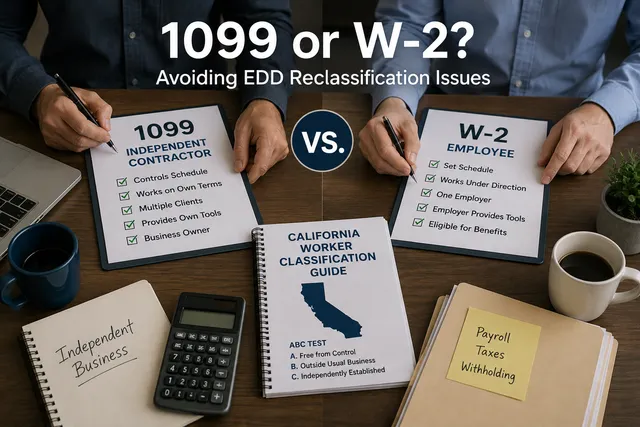
Worker classification is one of the highest-stakes operational challenges facing growing businesses today. As companies rely more heavily on remote workers, specialized consultants, and flexible teams, line-of-demarcation between an Independent Contractor (1099) and a W-2 Employee has become increasingly scrutinized by federal, state, and local agencies.
Misclassifying workers—even unintentionally—can lead to severe IRS penalties, back taxes, unpaid benefits claims, and costly legal disputes.
At NorthAmericanAccountax LLC, we help businesses navigate complex regulatory frameworks, establish compliant payroll systems, and safeguard their bottom line. In this guide, we break down the fundamental differences between 1099 contractors and W-2 employees, outline the legal tests used by regulatory agencies, and detail how to protect your organization from audit exposure.
The Fundamental Difference: Control vs. Independence
At its core, worker classification hinges on one primary question: How much control does your company exercise over how, when, and where the work is performed?
┌─────────────────────────────────────────────────────────────────────────────┐
│                       WORKER CLASSIFICATION SPECTRUM                        │
├──────────────────────────────────────┬──────────────────────────────────────┤
│             W-2 EMPLOYEE             │           1099 CONTRACTOR            │
├──────────────────────────────────────┼──────────────────────────────────────┤
│ • High behavioral control            │ • High operational autonomy          │
│ • Company dictates hours & tools     │ • Directs own work processes         │
│ • Paid regular salary or hourly rate │ • Invoices by project or milestone   │
│ • Receives benefits & tax withholding│ • Responsible for own taxes & tools  │
└──────────────────────────────────────┴──────────────────────────────────────┘
What is a W-2 Employee?
A W-2 employee works directly for your business under an employment agreement. The employer controls what work is done and how it is executed.
Key Responsibilities for Employers:
- Withhold federal, state, and local income taxes.
- Pay employer shares of Social Security (6.2%) and Medicare (1.45%) taxes (FICA).
- Pay federal (FUTA) and state (SUTA) unemployment taxes.
- Provide statutory benefits (e.g., workers’ compensation, state-mandated disability/leave).
- Issue Form W-2 by January 31 following the tax year.
What is a 1099 Independent Contractor?
A 1099 contractor is a self-employed individual or separate business entity engaged to perform a specific service or deliver a defined result. They retain total autonomy over how the task is accomplished.
Key Characteristics for Employers:
- No income or payroll tax withholding required.
- Payments made as gross amounts via accounts payable (not standard payroll).
- Issue Form 1099-NEC (Nonemployee Compensation) for payments exceeding $600 in a calendar year.
- Contractor manages their own self-employment tax (SECA) and operational expenses.
1099 vs. W-2: Side-by-Side Comparison
| Operational Area | W-2 Employee | 1099 Independent Contractor |
| Control of Work | Employer sets schedules, tools, training, and processes. | Contractor controls schedules, workflow, and execution. |
| Payment Structure | Hourly wages, salary, commission; paid on recurring schedule. | Flat project fee, hourly invoice, or milestone-based payments. |
| Tools & Equipment | Provided and maintained by the employer. | Provided, owned, and maintained by the contractor. |
| Business Expenses | Reimbursed by the employer. | Incurred and absorbed by the contractor. |
| Exclusivity | Usually works exclusively or primarily for your business. | Free to market services to other clients simultaneously. |
| Relationship Scope | Ongoing, indefinite engagement. | Project-based, temporary, or goal-defined engagement. |
| Tax Withholding | Income tax, FICA (Medicare/Social Security), unemployment. | Zero tax withholding by hiring company. |
| Annual Tax Form | Form W-2 | Form 1099-NEC |
How the IRS Evaluates Classification: The Common Law Rules
The Internal Revenue Service evaluates worker status based on three main categories of evidence: Behavioral Control, Financial Control, and the Type of Relationship.
“Under common-law rules, anyone who performs services for you is your employee if you can control what will be done and how it will be done. This is so even when you give the employee freedom of action. What matters is that you have the right to control the details of how the services are performed.”
— Internal Revenue Service (IRS Publication 15-A)
1. Behavioral Control
Behavioral control evaluates whether the business has a right to direct and control how the worker does the task.
- Instructions: Does the company dictate when to work, where to work, what tools to use, or what sequence to follow?
- Training: Providing mandatory, detailed training on procedures indicates an employer-employee relationship.
2. Financial Control
Financial control evaluates whether the business directs or controls the financial aspects of the worker’s job.
- Unreimbursed Expenses: Independent contractors are more likely to have unreimbursed expenses than employees.
- Investment in Facilities: Contractors typically invest in their own equipment, software, workspace, and tools.
- Availability to the Market: Does the worker advertise their services to the general public or hold a separate business structure (e.g., LLC, S-Corp)?
- Profit or Loss Realization: Contractors can make a profit or suffer a loss based on their management efficiency.
3. Type of Relationship
How the business and worker perceive their relationship shapes classification assessment.
- Written Contracts: A contract stating worker status provides intent, but contract language alone does not override actual working conditions.
- Employee Benefits: Providing pension plans, insurance, or paid vacation indicates employee status.
- Permanency: Long-term, indefinite arrangements lean heavily toward employee status.
- Core Business Activities: If a worker provides services that are key to the company’s primary operations, they are more likely to be classified as an employee.
State Level Scrutiny: The ABC Test
In addition to IRS rules, many states apply stricter standards to classify workers. The most notable is the ABC Test (adopted in states like California, Massachusetts, New Jersey, and others). Under the ABC Test, a worker is presumed to be an employee unless the hiring entity proves all three conditions:
┌─────────────────────────────────────────────────────────────────────────────┐
│                           THE ABC TEST STANDARDS                            │
├─────────────────────────────────────────────────────────────────────────────┤
│  [A] Free from Control: The worker is free from the control and direction    │
│      of the hiring entity in connection with performance of the work.   │
├─────────────────────────────────────────────────────────────────────────────┤
│  [B] Outside Core Business: The worker performs work that is outside the   │
│      usual course of the hiring entity's core business operations.          │
├─────────────────────────────────────────────────────────────────────────────┤
│  [C] Customarily Engaged: The worker is customarily engaged in an            │
│      independently established trade, occupation, or business.              │
└─────────────────────────────────────────────────────────────────────────────┘
Failing even one prong under state ABC rules automatically reclassifies the worker as an employee for state tax and labor law purposes.
The True Financial Risk: Penalties for Misclassification
The financial consequences of misclassifying W-2 employees as 1099 contractors can derail growing businesses. When federal (IRS) or state regulatory authorities audit your payroll, back-liabilities add up quickly.
                  ┌────────────────────────────────────────┐
                  │    TOTAL COST OF MISCLASSIFICATION    │
                  └───────────────────┬────────────────────┘
                                      │
         ┌────────────────────────────┼────────────────────────────┐
         ▼                            ▼                            ▼
┌──────────────────┐        ┌──────────────────┐        ┌──────────────────┐
│ BACK PAYROLL     │        │ IRS PENALTIES    │        │ STATE LABOUR     │
│ TAXES            │        │ & INTEREST       │        │ FINES            │
├──────────────────┤        ├──────────────────┤        ├──────────────────┤
│ • Employer FICA  │        │ • 1.5% - 3% wages│        │ • Workers' Comp  │
│   (7.65%)        │        │ • 20% unpaid FICA│          penalties        │
│ • Unpaid FUTA    │        │ • Statutory      │        │ • Back benefits  │
│   / SUTA taxes   │        │   interest rates │        │ • Overtime pay   │
└──────────────────┘        └──────────────────┘        └──────────────────┘
Potential Tax Liabilities Include:
- Unpaid Employment Taxes: Payment of employer Social Security and Medicare taxes (7.65%), plus federal (FUTA) and state (SUTA) unemployment contributions.
- Failure to Withhold Penalties: Under IRC Section 3509, intentional or negligent failure to withhold income taxes incurs statutory fines:
- 1.5% of wages paid if tax returns were filed correctly (doubled to 3.0% if Form 1099 was not filed).
- 20% of the employee’s share of FICA taxes (doubled to 40% if 1099 forms were missing).
- Interest Charges: Compounded interest applied to all unpaid tax liabilities from the original due date.
- Labor Law & Overtime Claims: Back pay for unrecorded overtime, mandatory meal breaks, minimum wage gaps, and unpaid statutory benefits.
Action Plan: 5 Steps to Protect Your Business
To minimize legal exposure and build audit-ready operational frameworks, follow these steps:
Step 1: Conduct a Worker Classification Audit
Review all current 1099 agreements. Evaluate whether contractors perform tasks central to your core operations, use company-issued hardware, or follow mandated work schedules.
Step 2: Implement Clear Written Agreements
Ensure all contractors sign comprehensive Independent Contractor Agreements. Contracts should clearly establish project scopes, payment terms, intellectual property assignment, and the contractor’s responsibility for their own tools, insurance, and taxes.
Step 3: Formalize Contractor Onboarding
Collect required tax and business identification documents before making payments:
- Form W-9: Request for Taxpayer Identification Number.
- Certificate of Insurance (General Liability or Errors & Omissions).
- Proof of business entity registration (LLC/Corporation status) where applicable.
Step 4: Separate Payment Systems
Never process contractor invoices through regular employee payroll systems. Contractor fees should flow through Accounts Payable, maintaining clear separation between wage distributions and vendor payments.
Step 5: Utilize IRS Determination (Form SS-8) When Uncertain
If you are unsure of a worker’s status, file IRS Form SS-8 (Determination of Worker Status for Purposes of Federal Employment Taxes and Income Tax Withholding). The IRS will review the operational environment and issue an official ruling.
Build a Compliant Payroll Infrastructure with NorthAmericanAccountax LLC
Managing workforce expansion requires striking a balance between operational efficiency and strict regulatory compliance. At NorthAmericanAccountax LLC, we partner with business leaders to eliminate compliance guesswork.
Our dedicated team provides complete support across:
- Tax Planning & Payroll Compliance: Structuring tax-optimized wage and compensation models.
- Automated Payroll Processing: Managing accurate W-2 payroll distribution and 1099-NEC filings.
- Accounting System Setup: Configuring seamless cloud accounting platforms tailored to modern workflows.
Take Control of Your Payroll & Tax Compliance Today
Don’t wait for an IRS audit notice to review your worker classifications. Contact NorthAmericanAccountax LLC to audit your payroll systems and protect your company’s financial future.
Visit us online: https://northamericanaccountax.com/
Schedule a Compliance Consultation: Reach out to our strategy team today to review your 1099 and W-2 workflows.